


Search
-
or select -

Mercedes-Benz EV battery care comes down to a few owner’s manual habits. Charge to about 80% on average, use DC fast charging when you need it, and never let the car sit empty. Here is what those habits look like, how battery health is judged, and what the battery warranty covers.
Good Mercedes-Benz EV battery care starts with charging to about 80% on average, which is the target in the EQE and EQB owner’s manuals. The 2024 EQE SUV and 2024 EQB Operator’s Manuals put it in one line: “Charge the high-voltage battery on average up to a state of charge of 80 %.” They add that charging time increases significantly above 80%. Mercedes-Benz Canada’s MY2025 EQE Sedan manual repeats the same advice.
Note the words “on average.” The manual does not ban a full charge before a long trip. It lists frequent full charging, especially without driving straight afterwards, as a habit that could accelerate battery aging.
You do not have to remember the number each night. The charging menu lets you select Home, Work or Standard charging programs. The driver display shows the maximum state of charge as per your setting. The EQE SUV manual also describes ECO Charging, which “limits the charging current at charging stations to conserve the vehicle’s battery.”
Our Mercedes-Benz app page says you can check your battery level and charging completion time from your smartphone. Connected feature availability varies by vehicle.
Use it when you need it. The manuals advise DC fast charging “only when required,” because frequent rapid charging could accelerate battery aging. The EQE SUV and EQB manuals say to “Rapid-charge the high-voltage battery with direct current (Mode 4) only when required.” On a road trip, we would treat that as required. For daily driving, a home or workplace AC charger does the job.
Mercedes-Benz also helps the battery accept a fast charge. When you navigate to a charging station, the manual explains, “the high-voltage battery is pretempered so that an optimum charging capacity can be reached.” The menu item is called Battery pretempering. The manual notes that pretempering has consequences for the remaining range.
Charging speed changes from one session to the next. The manual says charging time or power can be affected by high or low outside temperatures and by a low or high state of charge. Mercedes-Benz USA adds that charging times are estimated and may vary by location, equipment and other conditions.
The manuals name three habits: frequent 100% charges, frequent DC fast charging, and long idle periods in high temperatures. All lithium-ion batteries lose some capacity over time. The EQE SUV manual states that “the storage capacity of and the amount of energy available from the high-voltage battery decreases over the course of its life.” Your habits affect how quickly that happens.
Factors that “could accelerate the aging of the high-voltage battery”: “Frequent full charging (condition of charge 100%) of the high-voltage battery, in particular without subsequently driving directly afterwards”; “Frequent rapid charging with direct current (mode 4)”; “Leaving the vehicle idle for lengthy periods at high ambient temperatures”.
The warranty booklet says the same in its own words. It notes that the battery, “like all lithium-ion batteries, will experience gradual Capacity loss with time and use.” Gradual capacity loss “is not covered beyond the terms and limits specified in this Battery Limited Warranty.”

Leave it at 30–50% charge, not permanently plugged in, out of the heat, and check the charge level every six weeks. Lithium-ion batteries slowly lose charge on their own. The EQE SUV manual warns that “Exhaustive discharging can therefore occur if the vehicle is idle for several months. This can damage the high-voltage battery.” These steps come from the EQE and EQB manuals and the warranty booklet.
One more manual habit applies all year. Every six months, when the outside temperature is above 50 °F, park the vehicle overnight with a charge level below 20%. The manual gives no reason, so we simply pass the instruction along.
| Situation | What Mercedes-Benz recommends |
|---|---|
| Everyday charging | On average up to 80%; charging time increases significantly above 80% |
| DC fast charging | Only when required; use Battery pretempering when navigating to a charging station |
| Longer idle period | 30–50% charge, not permanently connected to power, out of high temperatures |
| While parked long term | Check every six weeks; charge if below 20%; keep the 12 V battery connected (EQE manuals) |
| Twice a year | Above 50 °F, park overnight with less than 20% charge |
| At 0% charge | Charge within 14 days (warranty booklet obligation) |
Sources: Mercedes-Benz 2024 EQE SUV and 2024 EQB Operator’s Manuals (US) and Mercedes-Benz Canada MY2025 EQE Sedan Operator’s Manual; Mercedes-Benz EQ Models Service and Warranty Information, MY2026. Reviewed 11/09/2026. Check the manual for your own model and model year.
Temperature changes range, charging speed and power output. The manuals ask for extra care in heat and in very cold weather. Central Virginia brings hot, humid summers and winter freezes. That is our local context, not a Mercedes-Benz service condition. The manual’s own wording covers both ends. Avoid long idle periods at high ambient temperatures, and keep a sufficient state of charge “especially at very low outside temperatures.”
On a cold morning, an EQE SUV may show “Wait in READY State Battery Is Warming Up.” The manual explains that the battery is warmed to operating temperature, which “can take a few minutes.” The manual also says high or low outside temperatures may impair the battery’s power output.
EV range can drop in cold weather. The federal site fueleconomy.gov reports that EV range can drop by 41% in cold weather in mixed driving, with the heater running. It also says preheating or pre-cooling the cabin while plugged in can extend your range. The manual’s advice to avoid direct sunlight matters on Richmond summer days.
Range alone is not the test. For warranty purposes, an Authorized Mercedes-Benz Dealership diagnosis determines battery capacity. The warranty booklet is direct about this. It says range estimates are “an imperfect measure of battery capacity because they are affected by additional factors separate from battery capacity.” Many things besides capacity move the range figure from day to day.
To make a battery warranty claim, the booklet says you present the vehicle to an Authorized Mercedes-Benz Dealership “so a diagnosis can be performed.” The booklet also states that the measurement method is “at the sole discretion of Mercedes-Benz.” We did not find a customer battery health report that Mercedes-Benz USA publishes for US owners.
For overall battery life, fueleconomy.gov cites a DOE study. It suggests EV batteries may last 12 to 15 years in moderate climates and 8 to 12 years in severe climates. That figure is for EVs in general, not a Mercedes-Benz rating.
In the MY2026 booklet: 8 years/100,000 miles for EQB, CLA 250, CLA350 and G580; 10 years/155,000 miles for EQE, EQS and their SUVs, whichever occurs first. The Battery Limited Warranty is in the Mercedes-Benz EQ Models Service and Warranty Information booklet. It supplements the New Vehicle Limited Warranty, which runs “48 months or 50,000 miles, whichever occurs first.” The battery coverage starts on the same date as the vehicle’s warranty. It covers the certified lithium-ion battery for the original and each subsequent owner.
| Model (as named in the booklet) | Term, whichever occurs first | Minimum capacity warranted |
|---|---|---|
| EQB | 8 years / 100,000 miles | 133 Ah or 160 Ah |
| CLA 250, CLA350 | 8 years / 100,000 miles | 133 Ah or 160 Ah |
| G580 | 8 years / 100,000 miles | 133 Ah or 160 Ah |
| EQE (sedan) | 10 years / 155,000 miles | 204 Ah |
| EQE SUV | 10 years / 155,000 miles | 204 Ah |
| EQS (sedan) | 10 years / 155,000 miles | 192 Ah |
| EQS SUV | 10 years / 155,000 miles | 197 Ah |
Source: Mercedes-Benz EQ Models Service and Warranty Information, Model Year 2026; the Model Year 2027 booklet, marked draft, shows the same terms. Reviewed 11/09/2026. The 2027 GLC Electric is not named in either booklet; check the booklet for your vehicle.
Two kinds of repair are covered. One is defects in material or workmanship to the battery after the vehicle warranty ends. The other is repair or replacement if capacity drops below the minimum in amp-hours during the coverage. The booklet notes that a repair “may not return the battery to an ‘as new’ or 100% energy content.”
Coverage applies in the United States and Puerto Rico, with the same geographic limits as the vehicle warranty. It does not apply to a vehicle declared a total loss. You can read the full terms in the Mercedes-Benz USA service and warranty booklets.
Questions about your EV’s battery or your next service visit?
Not following the manual’s charging procedures, parking over 14 days at 0%, incompatible charging devices and skipped required maintenance. The booklet lists exclusions that tie directly to everyday habits. These are the ones owners can control.
Maintenance matters as well. The booklet says all required maintenance services must be accomplished to keep your Battery Coverage valid. The FTC says you don’t have to use the dealer for routine maintenance to keep a warranty in effect. The exception: if the warranty says the work will be done for free, specific repair facilities can be required.


Mercedes-Benz calls Genuine Mercedes-Benz parts “the recommended replacement parts for your Mercedes-Benz vehicle.” Ask our parts department about the right part for your model, or see our order parts page.
Your service indicator and Maintenance Booklet set the visit. High-voltage work is for a qualified specialist workshop, and warranty repairs go to any Authorized Mercedes-Benz Dealership. The warranty booklet says the service due date is displayed in the instrument cluster. Your vehicle’s ASSYST PLUS service indicator and Maintenance Booklet set the timing. The manual adds that ASSYST PLUS “is only an aid,” so check the booklet too.
Mercedes-Benz USA says a two-year service coverage package is available for purchase with all-electric Mercedes-Benz vehicles. Its listed items include a dust filter change, an activated charcoal filter change, a brake fluid change, wiper blades and a multi-point inspection. Ask our advisors which visit your vehicle is due for.
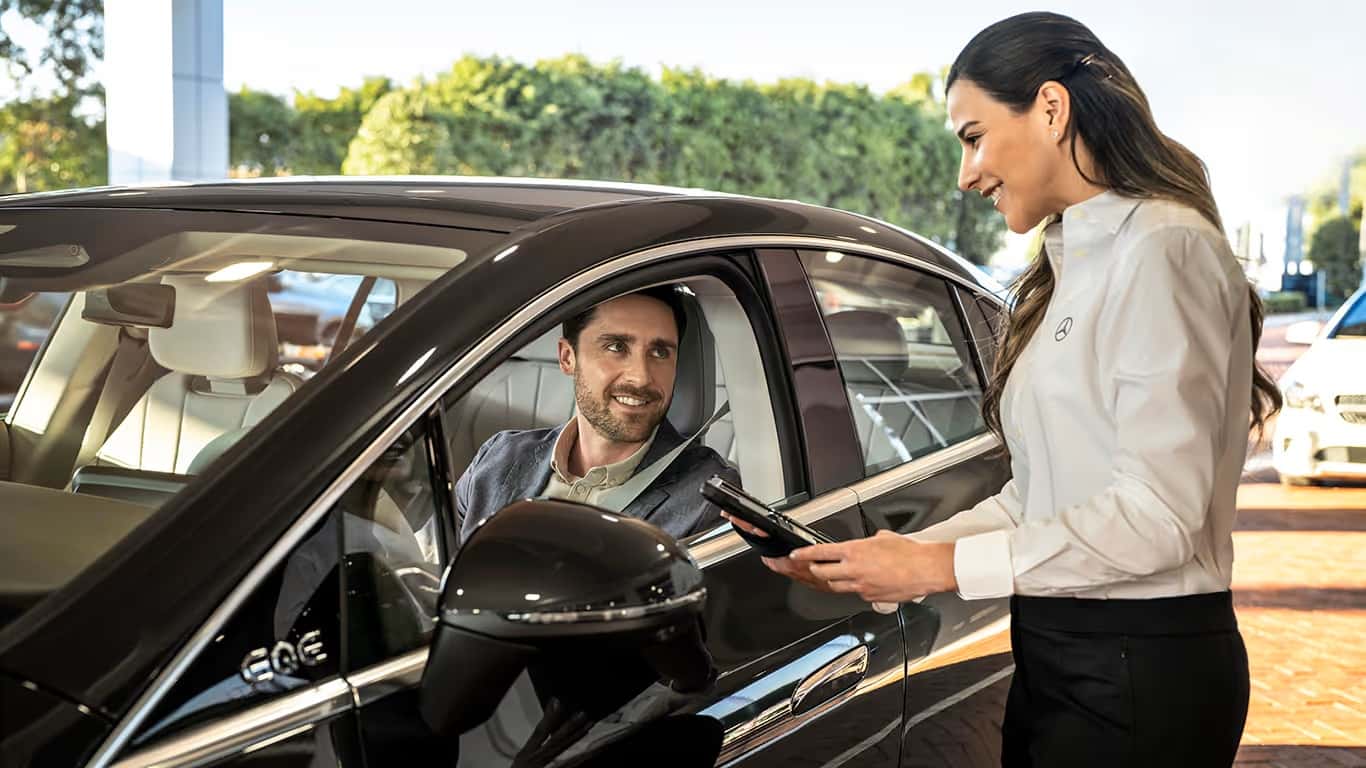
Leave high-voltage work to the workshop. The EQE SUV manual warns: “Do not perform any maintenance work during the charging process.” It also states that customer access under the hood is not permitted. EVs still need everyday care too, so see our tire center and brake service pages.
Our Mercedes-Benz service center is at 12200 Midlothian Turnpike. Our service page lists a complimentary new Mercedes-Benz loaner for select services when scheduled in advance; see demo and loaner vehicles. You can contact our service department or see our Mercedes-Benz service offers page. For a cost overview, read what Mercedes-Benz maintenance costs in Midlothian.
Read more on our Mercedes-Benz dealer in Midlothian and Mercedes-Benz dealer near Richmond pages. If you are shopping, you can see our electric Mercedes-Benz models, including the EQE SUV. Check open recalls by VIN at NHTSA.
Short answers about charging, battery health and warranty coverage.
Questions about your Mercedes-Benz EV? Call our service team at (804) 607-7529.
Yes, occasionally. The EQE and EQB manuals recommend charging to about 80% on average, not a strict cap. They list frequent full charging, especially when you do not drive straight away, as a habit that could accelerate aging. If you charge to 100% for a trip, time it so you leave soon after charging finishes.
No. The warranty booklet states the minimum in amp-hours, not a percentage. For example, it lists 204 Ah for the EQE and 197 Ah for the EQS SUV. If capacity drops below that figure during the coverage period, repair or replacement is covered. Capacity is determined by diagnosis at an Authorized Mercedes-Benz Dealership.
Yes. The booklet says Mercedes-Benz USA warrants the certified lithium-ion battery to the original and each subsequent owner. Coverage starts on the same date as the vehicle warranty, so a later owner gets whatever time and mileage remain. Pass the service records to the next owner with the car.
Charge it as soon as you can. The warranty booklet requires charging within 14 days after the display reaches zero, and it excludes damage from parking more than 14 days at 0%. The manual also warns that deep discharge over several months can damage the high-voltage battery. If the car cannot be driven, the booklet lists 24-Hour Roadside Assistance at 1-800-FOR-MERCedes.
The manuals advise against leaving it permanently connected during a long idle period. Instead, park with the battery between 30% and 50%, out of high temperatures. The EQE manuals also say to keep the 12 V battery connected. If someone can check on the car, have them look every six weeks and charge it if the level is below 20%.
The owner’s manuals simply state that charging time increases significantly from a state of charge of 80%. The manual’s DC charging-time figures are also measured from 10% to 80% of usable energy content. On a road trip, it often makes sense to charge to around 80% and move on, rather than wait for the last part.
The manuals do not give a day count. They simply say that if the vehicle will be idle for a longer period, park it between 30% and 50% charge. The hard limit in the warranty booklet is different: charge within 14 days after the display reaches zero. For a trip of a few weeks, setting 30% to 50% before you leave is a simple habit.
The FTC says you do not have to use the dealer for routine maintenance to keep a warranty in effect. The exception is a warranty that says the work will be done for free. The Mercedes-Benz booklet does require all scheduled maintenance to keep battery coverage valid. Opening or servicing the battery itself is for an Authorized Mercedes-Benz Dealership.
No. The warranty booklet describes 24-Hour Roadside Assistance as a separate service from any warranties on your vehicle. It is reached through a toll-free call listed in the booklet. Warranty repairs are made at an Authorized Mercedes-Benz Dealership. The New Vehicle Limited Warranty section says warranty repairs will be made at no charge for parts and labor.
We could not confirm it. The Model Year 2026 and draft 2027 EQ warranty booklets name the EQB, CLA, G 580, EQE and EQS. They do not name the GLC Electric. Check the warranty booklet that came with your vehicle, or ask our service advisors to look up the coverage for your VIN.


Bring your all-electric Mercedes-Benz, your maintenance records and any battery messages you have seen, and ask about the visit your service indicator shows. Our service department is at 12200 Midlothian Turnpike.
Follow the charging habits in your manual, then let our service team handle scheduled maintenance and any battery messages.
Service: (804) 607-7529
Sources reviewed 11/09/2026: Mercedes-Benz USA, Mercedes-Benz EQ Models Service and Warranty Information, Model Year 2026, and Model Year 2027 booklet (marked draft); Mercedes-Benz 2024 EQE SUV and 2024 EQB Operator’s Manuals (US) and Mercedes-Benz Canada MY2025 EQE Sedan Operator’s Manual; mbusa.com electric vehicle, model and service pages; FTC, Auto Warranties and Auto Service Contracts; fueleconomy.gov all-electric vehicle, cold weather and hot weather pages. Owner’s manual guidance is quoted from the models named; check the manual and warranty booklet for your own vehicle, which govern. Warranty terms are summarized; the full booklet terms, conditions and exclusions apply. Charging times are estimated and may vary by location, equipment and other conditions. Connected feature availability varies by vehicle. Mercedes-Benz and the three-pointed star are trademarks of Mercedes-Benz Group AG. Federal agencies named here do not endorse this dealership.